



Summer Practice Course Review | Design and Practice of Smartphone Microscopy Based on 3D Printing
July 26, 2024
In July 2024, the "Xuesen Summer Challenge Program" of the School of Biomedical Engineering at Shanghai Jiao Tong University, together with the Qingpu Senior High School "Science Innovation Summer Camp," offered a total of four practice courses. Among them, the practice course "Design and Practice of Smartphone Microscopy Based on 3D Printing" was led by Professor Yang Jianlong from the School of Biomedical Engineering. The course guided students to understand the principles, technologies, and applications of smartphone-based biomedical instruments, and to design, model, and assemble a low-cost, focusable smartphone microscope using their own phones, 3D printers, and camera modules from discarded phones.
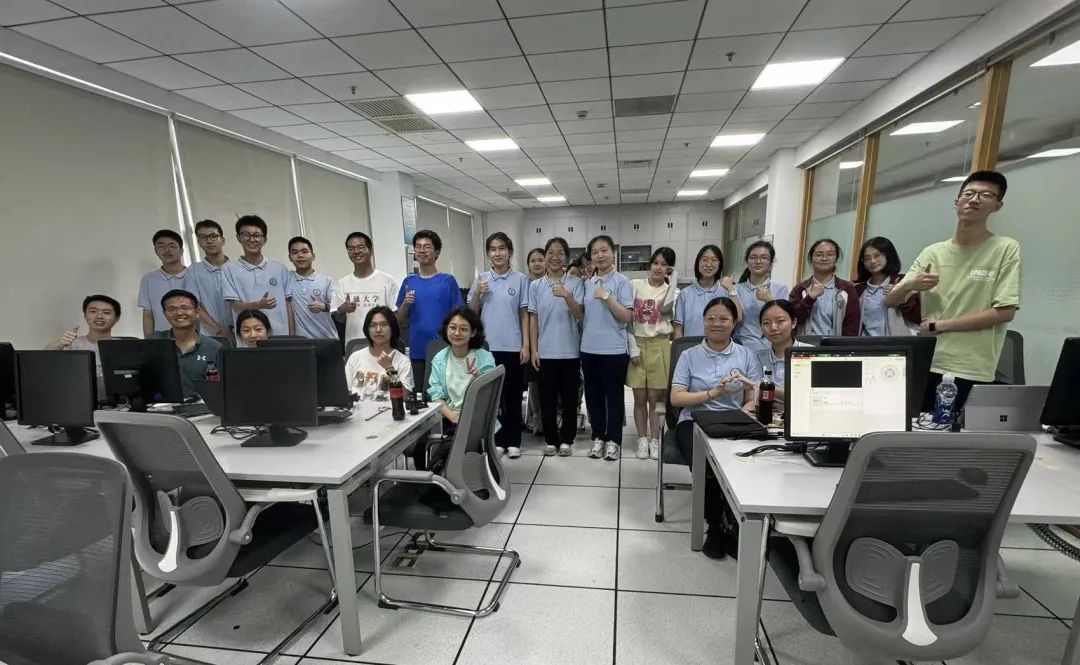
Course Introduction
With the development of technologies such as semiconductors, integrated sensors, and artificial intelligence, smartphones have acquired robust integrated information processing capabilities while becoming increasingly portable. As a result, smartphone cameras can be applied to certain biomedical detection tasks, and the smartphone microscope designed and built in this course is precisely one such example.
In this course, students used their own smartphones, 3D printers, and camera modules from discarded phones. Under the guidance of the instructor, they modeled, assembled, and produced a low-cost, focusable smartphone microscope, and then used their self-made microscopes to observe the cellular structures of biological tissue samples. Based on these outcomes, they completed experimental reports and presentations.
Course Process
Most students were encountering the field of biomedical engineering—a discipline that sounds highly advanced—for the first time, and they showed great enthusiasm. In class, Professor Yang patiently explained the principles of optics, 3D printing techniques and methods, and, together with the teaching assistants, guided the students in learning to use SolidWorks software. Under the careful guidance of the instructors, students started with simple modeling exercises and gradually learned to design and successfully produce their own smartphone microscopes.
Project Showcase
After five days of theoretical and experimental learning, all students successfully produced their own microscopes. Moreover, building upon the instructor's base design, they proposed their own innovative design improvements and optimized their models, making the smartphone microscopes more user-friendly and adaptable to a wider range of scenarios.
On the final day of the course, students presented their results, showcasing each group's final design outcomes and offering future prospects for the project. The instructors and teaching assistants gave high praise to all participants. Among them, the group "MADA," consisting of Hu Jingle, Zhang Ziqi, and Wang Zida, was recognized as an outstanding group for their work "Low-Cost, Multi-Functional, Highly Adaptable Smartphone Microscope Stand," which was distinguished by its innovative design, structural completeness, and clarity of presentation. Their project was showcased to all camp participants. In addition, based on class performance and final presentations, Lu Kegang, Chang Mozhen, and Sun Haoran were named Outstanding Campers.
Address:Wenxuan Building, 800 Dongchuan RD, Minhang District, Shanghai, China
Tel: +86 21 34204018
Zip: 200241
Address:No3 Teaching Building, 1954 Huashan RD, Xuhui District, Shanghai, China
Tel: +86 21 62933344
Zip: 200030

BME WeChat
copyright: Copyright@2018 School of Biomedical Engineering, Shanghai Jiaotong University
Shanghai Jiaotong ICP Bei 05227
沪交ICP备20210179